Another nice mess
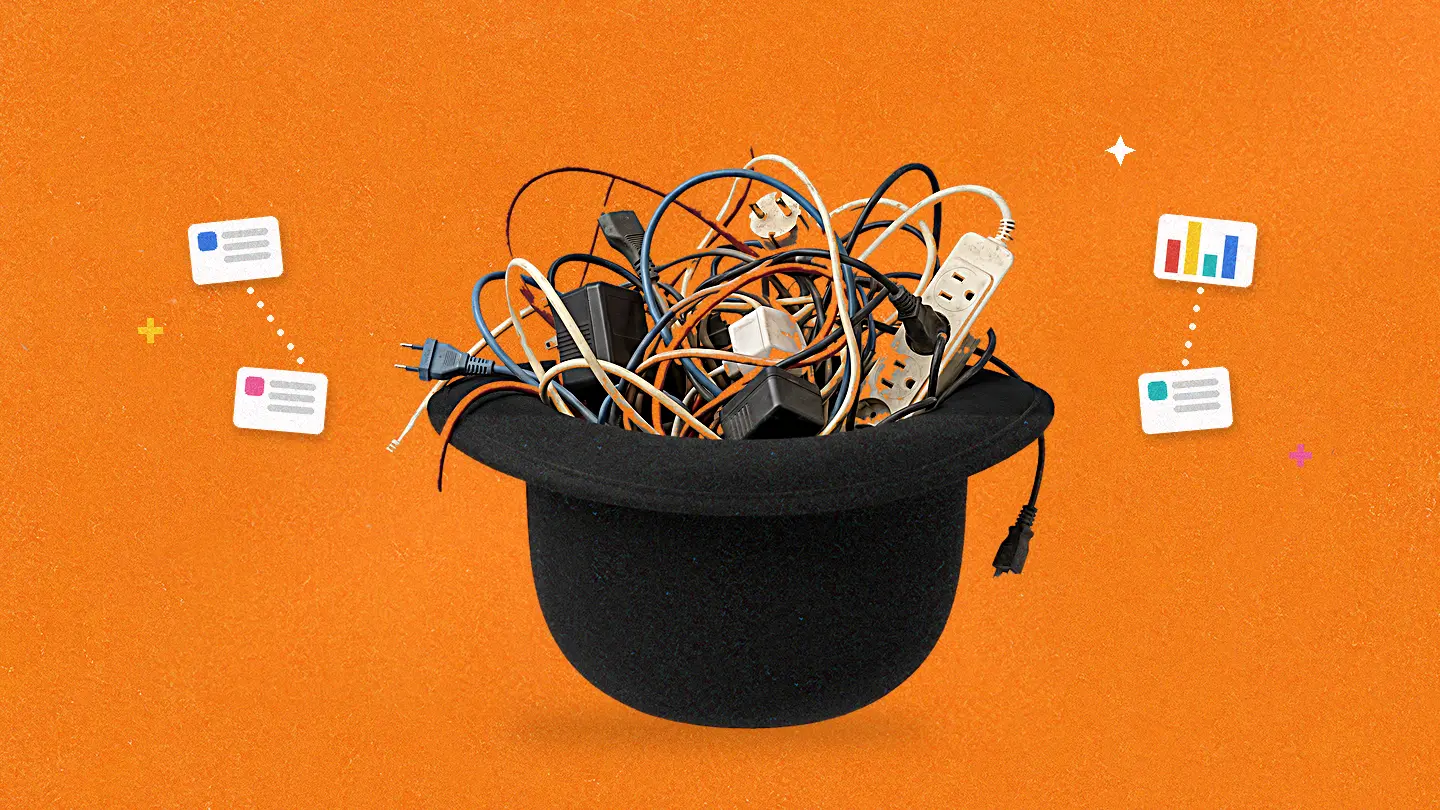
Somewhere in your business right now, someone is assembling a picture that no single app can provide. It may be the project manager pulling hours from Harvest and budget data from the finance tool to assess whether the engagement is still viable. Maybe it’s you on a Sunday, because what you need is not any one number from a system, but the pattern across three of them. The cloud gave small businesses access to the best software they had ever had, priced monthly and built for specific purposes. But twenty years of sensibly chosen apps have left the average small business with a patchwork data estate. That was tolerable until it wasn’t. AI has made tackling this lurking issue urgent.
The year it got cheap to start a software company
Before March 2006, building a software company required buying the infrastructure before you had a single customer. You bought actual servers, paid upfront for the capacity you hoped you’d eventually need, and hired staff to keep it running. Guessing your traffic wrong in either direction was expensive. Then Amazon switched on a storage service called S3 and added rentable computing through EC2 later the same year, and the economics of the whole industry tilted on its axis.
What changed was the accounting category. Servers shifted from capital expenditure to operating cost, becoming a metered bill that rose with use rather than a sunk cost before you had earned anything. The cost of starting a software company fell to a laptop, a credit card, and a good idea. Two things followed: the cost of serving one more customer fell toward zero, because distributing software to a new user is just copying bits, and the main cost shifted to reaching customers. But this could now be done at the scale of the global internet, with advanced digital advertising tools enabling precise cost-per-acquisition and cohort analysis.
As a result, software-as-a-service—the model of renting software by the month through a browser—spread into every niche that a reasonable number of paying subscribers could support. Somewhere out there is software for orthodontists who also breed koi. It has 400 paying subscribers and a product roadmap. Good luck with it. Ben Thompson’s Aggregation Theory explains what happened at the top of the market, where zero distribution costs and direct user relationships combine to produce winner-takes-most outcomes. A handful of companies rode that logic all the way to infrastructure-level dominance. But below them, in the comfortable middle, thousands of moderately successful tools settled in to do one specific job well, with a bill small enough that nobody ever quite got around to cancelling.
For small and medium businesses, this was the best thing to happen to the back office in a generation. The incumbent alternative was enterprise software from Oracle or SAP, designed for multinationals, priced for multinationals, and customised by consultants at rates that would make a barrister wince. What the SaaS era produced instead was software built by someone who actually understood your trade, at a price closer to a gym membership. The dog groomer got booking software that understood cancellation patterns and Afghan Hounds. The film production company received project tools, including daily call sheets and time codes, rather than generic task lists. For the first time, the small operator was the intended customer rather than the afterthought.
Integration is not the same as orchestration
The adoption was rapid and generated an unexpected but predictable problem. The average company now runs more than 100 SaaS tools. Most of them have integrations. Salesforce talks to Mailchimp. Harvest syncs with Xero. Slack has a connector for almost everything, and Zapier has built an entire business out of being the glue between tools that would otherwise remain separate. The problem is not that these tools are isolated. It is that connecting them in pairs does not produce a coherent picture of your business; it just shuttles data to and fro.
Consider what it takes to know whether a client project is going off the rails. You need the hours logged in Harvest, the tasks completed against scope in the PM tool, the contract in Notion, the relationship history in HubSpot, and a read of the Slack thread where the client mentioned a few extra things they’d like included, with a suspicious lack of detail about whether they would be paying extra. Each of those sources has integrations. None of those integrations, combined, gives you the full picture. Getting that still generally requires a person to hold the pattern in their head and assemble it by hand.
Enterprises have been solving this at a layer above individual apps for years. MuleSoft, which Salesforce bought for $6.5 billion in 2018, is an integration platform that sits across the stack and orchestrates data flows between systems that would otherwise remain local. Boomi does similar work. So does Workato. These platforms exist precisely because connected apps are not a coherent view of the business. Whether you call it integration middleware or an iPaaS, the principle is the same. You need something that sees the whole board, not just the individual pieces.
That layer has never been affordable for a small business. MuleSoft licensing starts in the tens of thousands before anyone is paid to configure it, and configuration makes up most of the cost. So the small operator ends up with individual integrations and loses the orchestration that provides the cross-cutting picture.
The seams
An AI agent is only as useful as what it can see and touch. Point one at a single tool, and it can do that tool’s job capably. Ask it to do something that resembles running a business — to notice that a project is burning budget faster than it is delivering scope, or that an invoice has aged past the point where a polite nudge still works — and it has to read across the seams between systems built over twenty years of separate SaaS procurement. For a small business, the value of an AI agent lives almost entirely in those gaps.
The SaaS inheritance turns sour in another way, too. An AI agent doesn’t arrive and sort things out; it inherits whatever state your data is in and acts on it with full confidence and little basic discretion. A well-organised, connected data estate gives you the foundation for an agent that does useful work. The usual half-duplicated, nobody-updated-this, three-versions-of-the-same-client-name reality gives you one that can be unusable for an agent, or skews it into being fluently, confidently wrong.
This is the real irony. The businesses that embraced SaaS most enthusiastically—the ones that found a better tool for every problem and added it—are now sitting on the thickest tangle of seams. The diligent adopter of the last technological leap can therefore be the least prepared for this one. The last great leap forward is sitting on the chest of the next one.
What a thin layer can do
The fantasy solution is to throw out the stack and start again with a clean, integrated system. No business with customers and deadlines will do that, and they shouldn’t have to. The practical step is to stop trying to fix the individual apps and instead build something that works in the gaps between them. Enterprises have MuleSoft and Boomi for exactly this, but anyone who has worked with these tools will know they are not magic cure-all panaceas for awful enterprise and data architecture. The combination of AI and a new generation of integration tooling is how you build a version of that capability without the enterprise price tag or the need for an implementation team.
That is the architecture behind a project we’ve been building, called Project Megatron - a Peep Show reference rather than a Transformers one. The design is intentionally modest. A thin software layer sits across the tools you already use, reads the signals each one produces, applies the rules you’ve set, drafts whatever action should follow, and then stops and waits for a person to approve it. It reads from anything with an API. It writes nothing without approval, and even then, only to a pre-cleared set of actions and tools. A human still owns every final step.
Most of the work in building something like this used to disappear into custom plumbing, a bespoke connection built and maintained for each individual tool, each one a small permanent maintenance tax. Vendors change their APIs, authentication flows shift, data schemas drift, and every one of those connections is yours to repair the morning it breaks. The newer approach relies on the Model Context Protocol, an open standard for connecting AI to other software through a single consistent interface rather than a row of hand-rolled ones. Where a vendor has built an MCP server, the maintenance burden shifts to them.
What makes this safe is the order in which you switch it on. You start in read-only mode, with the layer watching and surfacing but changing nothing, on work where a wrong answer costs almost nothing. An aged invoice report that it hands you is just a list. Only once it has earned some trust do you let it draft things that eventually leave the building, and even then, a person reads and sends. The agent who spots “while we’re at it” in a Slack thread and drafts a change order before the work has started, and the one who compresses the half-day status report ritual into a fifteen-minute review and hands you a draft. They don’t press send. You stay in control. As we like to say, the robots do the dishes.
The obvious objection is that every app you already own is in the process of bolting AI onto itself. Salesforce has Einstein. HubSpot has Breeze. Run ten tools, and you will soon have ten separate AI systems, each making decisions about a slice of your business with no knowledge that the other nine exist. That is the same patchwork as before, only now every patch has opinions. The case for owning the orchestration layer rather than renting ten that don’t talk is one we’ve made at length. The coordination layer is where your operational logic lives. It is not something to spread across a dozen vendor contracts, piece by piece. We’ve started running these harnesses for the businesses we work with, one read-only loop at a time, adding a rung only when the last one has earned it.
First, find out how bad it is
Before any of that comes the step most owners skip: the answer, which is uncomfortable. Working out what condition the estate is actually in. Not a vague impression, a proper number. We built a ten-question diagnostic that takes about two minutes, requires no sign-up, and produces a single score. The score answers one practical question. What kind of agent would you actually get today? The helpful kind, or the confidently wrong kind?
Oliver Hardy said, sixteen times across his films, “here’s another nice mess you’ve gotten me into”, delivered at Stan with that long-suffering look directly into the camera. Every app in your stack was probably the right choice when you added it. But as they’ve accumulated, you’ve likely noticed that together they deliver less than the sum of their parts. For companies serious about capturing the benefits of AI, single-point integrations and human workarounds need to be weeded out. Only once the mess is fixed can we reliably set the robots to work.
Like this? Get email updates or grab the RSS feed like it’s 2008.
More from the blog
-

Workslop: worse but more
In November 1955, a naval historian named C. Northcote Parkinson opened [a satirical essay in The Economist](https://en.wikipedia.org/wiki/Parkinson%27s_law) with a line that outlasted everything else he wrote. Work expands to fill the time available for its completion. His example was an elderly lady who spent an entire day posting a single card to her niece, a task a busy person would finish in three minutes on the way to lunch.Parkinson’s law now has a sequel, and it is worse. Work no longer expands to fill the time. It expands to fill the capacity. The effort of producing a thing used to …
-

Foomers vs doomers: skilled incompetence and the AI tug of war
foom-er, noun, an ironic malapropism playing on doomerism (AGI fatalists) and FOMO (hustle bros), used to describe techno-optimists. Reflects the onomatopoeic "slowly, then all at once" nature of exponential growth: “AI go foom.”A speaker at one of the many AI conferences that have sprung up like garments on your "clothes chair" (not clean, but not dirty enough to wash) describes the miracles of agent-assisted coding. Year-long rewrites finished in a fortnight, backlogs cleared, and hard problems dissolved by brilliant prompting and clever code harnesses. The audience of true believers laps i…
-

Forward Deployed Engineers: AI’s hired guns
> The last mile of AI deployment is a real person, sitting in your office, learning your business, writing your plumbing, and making things work reliably. That will remain human for the foreseeable future.Google Trends shows a 5,000% increase in searches for "AI forward-deployed engineer" over the past five years. The curve stays flat from 2021 through mid-2024, then turns vertical. [Indeed data reported by Business Insider](https://www.businessinsider.com/ai-forward-deployed-engineer-career-job-openings-tech-2026-5) shows postings for the role rising from 643 in April 2025 to 5,330 a year la…
-
The sorting machine: recruitment’s race to the bottom
> The sorting machine was built to cope with a genuine problem. Where it went wrong was in mistaking efficiency for effectiveness, in assuming that the ability to process resumes fast meant the ability to evaluate candidates well. The fix is not a smarter machine but a more modest one, paired with humans who are given the time, the tools, and the structured information to do what they were always better at.If you've been involved in any part of the recruitment process, the last 18 months have been dispiriting, to say the least. Hiring became a closed loop. Employers adopted applicant tracking…
-

Weighing smoke: why GEO dashboards are mostly useless
> The promise of a tool that gives you similar search visibility to the pre-agent world is understandably seductive. But before you eagerly hand over your cash for a platform, consider whether an afternoon's work a month might be a more cost-effective alternative.I recently wrote about [the GEO chimera](https://betterthangood.xyz/blog/geo-practice-versus-snake-oil/), the cottage industry promising to optimise your brand into AI answers. My argument was that the levers being sold mostly did not exist. Another part of the industry is selling gauges rather than levers. Estimates of the spend on …