Workslop: worse but more
By Iain, : AI, Process, Hot takes

In November 1955, a naval historian named C. Northcote Parkinson opened a satirical essay in The Economist with a line that outlasted everything else he wrote. Work expands to fill the time available for its completion. His example was an elderly lady who spent an entire day posting a single card to her niece, a task a busy person would finish in three minutes on the way to lunch.
Parkinson’s law now has a sequel, and it is worse. Work no longer expands to fill the time. It expands to fill the capacity. The effort of producing a thing used to carry an implicit question, namely, whether the thing was worth the effort. That cost has fallen to near zero, and the question has disappeared along with it. We have stopped asking whether the work needs to exist, because making it no longer costs us anything we notice.
The filter was the friction
Read the original law carefully, and you realise the mechanism is friction, not time. The lady’s day fills up because each sub-task carries its own small tax of effort, and effort is what prevents a task from metastasising. When a memo took an afternoon to write, the afternoon was the barrier. You wrote the memo only if it truly earned an afternoon’s effort. Most of the time, it didn’t, so most stayed unwritten, and the unwritten things were, on the whole, the ones nobody needed.
This is also the part of knowledge work that nobody enjoyed. The slide deck that swallowed a day to prepare, the deep competitor analysis that took up a week. The labour requirement was a kind of virtual toll booth of your time. Generative AI has stripped away the toll booth. The deck is now done in four minutes. The competitor analysis a single prompt.
Bloat is what you get
When supply costs nothing, it floods out. We now have the early measurements, and they indicate an approaching tsunami.
Researchers at Stanford’s Social Media Lab and BetterUp gave the phenomenon a name in the Harvard Business Review last September. “Workslop”, as they call it, is defined as AI-generated content that masquerades as good work but lacks the substance to meaningfully advance a task. Two in five workers had received some. Each instance costs the recipient close to two hours to untangle, because the burden of absent thought does not vanish; it simply moves downstream to whoever has to read it and work out what was actually meant. The sender saved an afternoon. Three colleagues each lost one.
The same pattern shows up in code, where it is easier to count. GitClear’s analysis of 211 million changed lines found that copy-pasted code overtook reused code for the first time in 2024, while the share of changes that were refactoring fell from a quarter in 2021 to under a tenth. Duplicated blocks rose eightfold. AI assistants are very good at producing a plausible new function and very bad at noticing that the function already exists three files away. So the codebase steadily grows. It is the literal antithesis of Dieter Rams’ philosophy of “less but better”
The question deleted
None of this is the model’s fault. A model does what it is asked, and it is being asked to produce, never to question whether producing is worthwhile. The discipline that is vanishing is the judgement to decide “Is this necessary?” “Does it add anything the last version did not?” “Would its absence be noticed by anyone other than the person whose job it is to produce it?”
Those questions used to get answered because skipping them meant paying for work you did not need. Now, skipping them is free at the point of creation and expensive everywhere downstream—in the reading, the reconciling, the maintaining, and the quiet erosion of trust that sets in when a colleague learns your documents are more complex than your thinking. The HBR researchers found that the interrelational costs are high. Around half of the people who received “workslop” rated the sender as less capable than they had been before.
The fix is to put the gate in front of the tool rather than behind it—before the prompt, not after the draft. The question is whether something should be written or made at all. Never has the old axiom, “just because you can doesn’t mean you should”, felt more important.
Wondering if we’re a fit for your project? Ask your AI. It’ll read up on us, ask you a few questions and start the conversation.
More from the blog
-
Chaos or death
> AI has made disorder cheap to create. Order still costs leadership attention and decisions, and most firms buy only the tools.I spend a lot of time in other people's messes. That is, more or less, my job. A company calls because its technology initiative has stalled, and I always find the same scene, just in a different company. Everyone agreed on a strategy deck, and nobody followed it. Staff are using AI tools the business never chose, and Harmonic Security [tracked 665 of them](https://www.harmonic.security/resources/what-22-million-enterprise-ai-prompts-reveal-about-shadow-ai-in-2025) a…
-

Foomers vs doomers: skilled incompetence and the AI tug of war
foom-er, noun, an ironic malapropism playing on doomerism (AGI fatalists) and FOMO (hustle bros), used to describe techno-optimists. Reflects the onomatopoeic “slowly, then all at once” nature of exponential growth: “AI go foom.”A speaker at one of the many AI conferences that have sprung up like garments on your “clothes chair” (not clean, but not dirty enough to wash) describes the miracles of agent-assisted coding. Year-long rewrites finished in a fortnight, backlogs cleared, and hard problems dissolved by brilliant prompting and clever code harnesses. The audience of true believers laps i…
-

Forward Deployed Engineers: AI’s hired guns
The last mile of AI deployment is a real person, sitting in your office, learning your business, writing your plumbing, and making things work reliably. That will remain human for the foreseeable future.Google Trends shows a 5,000% increase in searches for “AI forward-deployed engineer” over the past five years. The curve stays flat from 2021 through mid-2024, then turns vertical. Indeed data reported by Business Insider shows postings for the role rising from 643 in April 2025 to 5,330 a year later, a 729% increase. LinkedIn’s own study found 42-fold growth between 2023 and 2025, making fo…
-
The sorting machine: recruitment’s race to the bottom
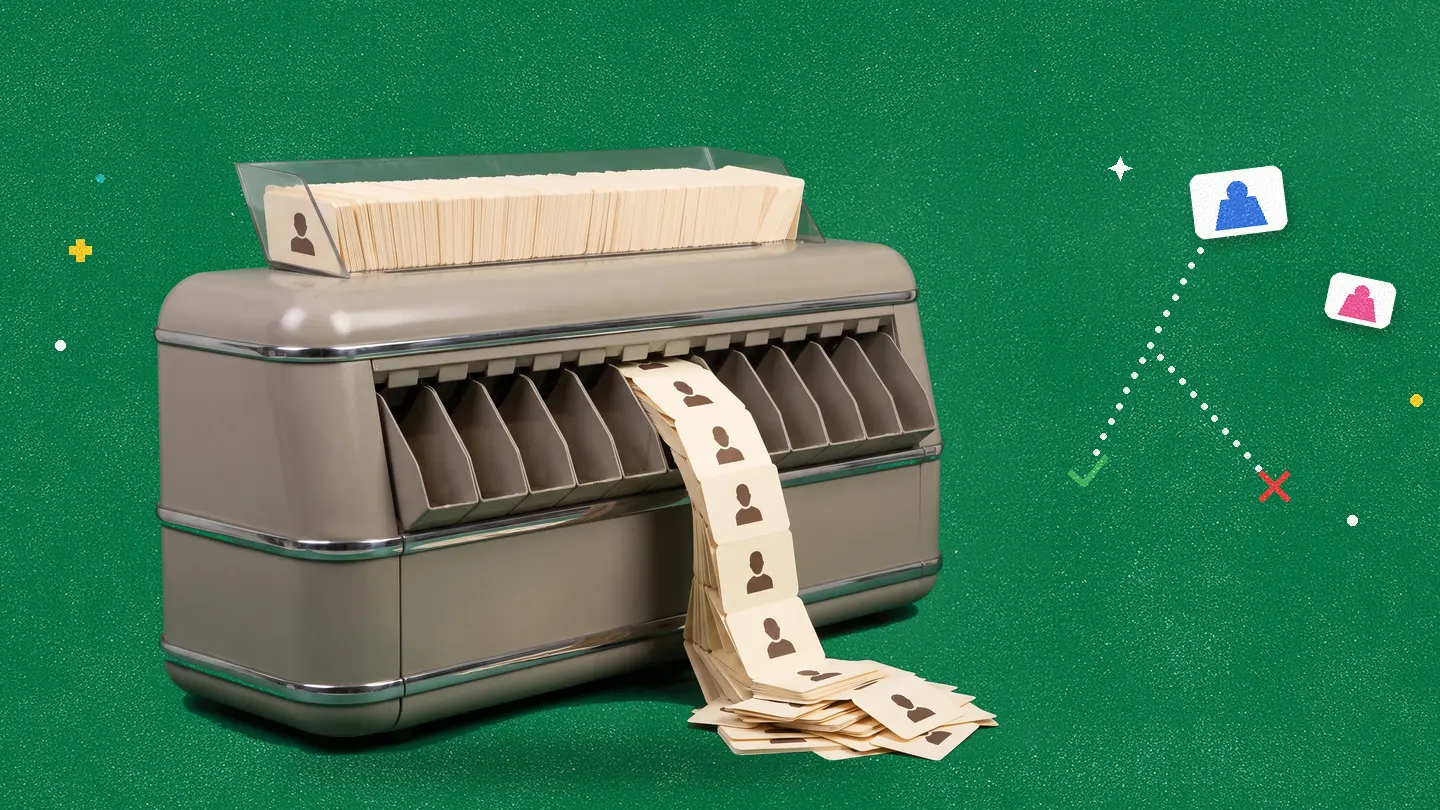
The sorting machine was built to cope with a genuine problem. Where it went wrong was in mistaking efficiency for effectiveness, in assuming that the ability to process resumes fast meant the ability to evaluate candidates well. The fix is not a smarter machine but a more modest one, paired with humans who are given the time, the tools, and the structured information to do what they were always better at.If you’ve been involved in any part of the recruitment process, the last 18 months have been dispiriting, to say the least. Hiring became a closed loop. Employers adopted applicant tracking…
-

Weighing smoke: why GEO dashboards are mostly useless
The promise of a tool that gives you similar search visibility to the pre-agent world is understandably seductive. But before you eagerly hand over your cash for a platform, consider whether an afternoon’s work a month might be a more cost-effective alternative.I recently wrote about the GEO chimera, the cottage industry promising to optimise your brand into AI answers. My argument was that the levers being sold mostly did not exist. Another part of the industry is selling gauges rather than levers. Estimates of the spend on AI visibility tracking now run past $100 million a year, across hu…